
Tamanrasset and Hoggar: Journey to the Heart of Saharan Volcanism and Touareg Renaissance
🏆 Tamanrasset: Capital of the Blue Men
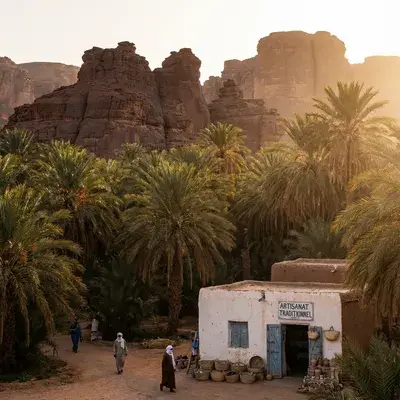
Perched at 1,400m altitude, Tamanrasset (Tamenghest) is the mythical capital of Hoggar. This is where the heart of Touareg culture beats. A city of encounters, it houses the memory of the friendship between Amenokal Moussa Ag Amastan and Father de Foucauld. It's the mandatory starting point for all expeditions to Assekrem or Tassili Hoggar.
Table of Contents
- Tamanrasset 2025: Strategic Repositioning
- Hoggar Geology: World-Class Volcanic Artifact
- Climate, Biodiversity and Fragile Ecosystems
- Kel Ahaggar: Culture, Matriarchy and UNESCO Heritage
- Massive Infrastructure: Railway, Energy, Digitization
- Logistics, Visas and Access 2025
- Exploration Circuits: 5 Options from Classic to Extreme
- Spiritual, Archaeological, Scientific Dimensions
- Sustainable Tourism: Managing Ecological Fragility
- Safety, Health and Field Realities
- Economic Perspectives: Hoggar’s Transformation
Tamanrasset 2025: Strategic Repositioning {#repositioning}
Tamanrasset is not just a tourist destination. It embodies a historic moment: the transition from an inaccessible fortress to an African geopolitical crossroads where Algerian economic diversification, continental energy innovation, and the resurrection of threatened Touareg cultural heritage converge.
The 2022-2025 Acceleration
Three major transformations have redefined the landscape:
1. Visa on Arrival Revolution: Since 2022, the “regularization visa” has abolished long consular delays. You land in Tamanrasset, fill out a form at local immigration (30 minutes), pay 110€, and you’re in.
2. Algiers-Tamanrasset Railway Project (2,406 km, $2.6 billion): The presidential decree of 2025 commits Algeria to the most ambitious Maghreb infrastructure project since independence. Target completion 2028 redesigns accessibility. From 36 hours of chaotic driving to 15 hours of air-conditioned train Algiers-Tamanrasset.
3. Strategic Renewable Energy Hub: Tamanrasset has an annual solar radiation of 368.7 GWh/km² — Algeria’s highest, equal to Arizona. Green hydrogen initiatives (Franco-Algerian-German) transform Hoggar into an African energy laboratory.
Hoggar Geology: World-Class Volcanic Artifact {#geology}
Lithospheric Uplift Complexity
The Hoggar rests on a lithospheric swell (~1,000 km diameter) initiated in the Cretaceous. The mechanisms include:
- Post-collision lithospheric mantle delamination Africa-Eurasia (Alpine)
- Residual mantle plume of secondary importance
- Inherited Proterozoic faults channeling magmatism
The Atakor: 250 km³ of Magmatic Violence
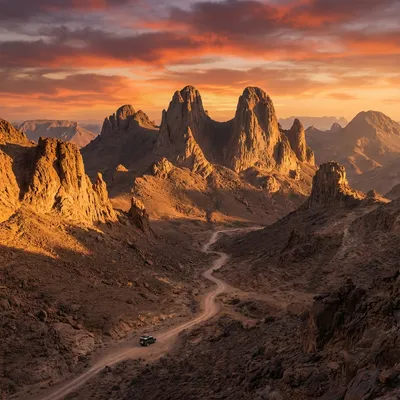
The Atakor massif (2,150 km²) is the volcanic heart. Since the Miocene, it has ejected ~250 km³ of magmatic material in three distinct phases:
| Phase | Period | Magmatism | Resulting Landscape |
|---|---|---|---|
| Phase I | Miocene (~23-16 Ma) | Trachytes, early phonolites | Massive base domes (eroded) |
| Phase II | Miocene-Pliocene (6.7-4.2 Ma) | High viscosity phonolites | Spectacular needles (Tizouyag, Ilamane, Sawinan) |
| Phase III | Plio-Quaternary (<1.95 Ma) | Fluid basalts | Extended flows, fresh scoria cones |
Petrogene Duality: Black and Pink
The Hoggar’s aesthetics come from the chromatic and morphological contrast between two magmatic families:
Mafic Basalts (deep black, dark blue)
- Low viscosity → flow 50-100 km
- Forms: tabular plateaus, frozen lava fields
Felsic Phonolites (pale pink, light green)
- Very high viscosity → vertical accumulation
- Forms: domes, hexagonal “organ pipe” needles
- Location: Assekrem, Tizouyag, Mount Tahat
Climate, Biodiversity and Fragile Ecosystems {#climate}
The Island of Freshness: Unique Thermal Oasis
At 1,400 m altitude, Tamanrasset offers a glacial breath against desert suffocation. Summers are hot (max ~38°C) without being suffocating. Winters see regular night frosts from 2,700 m.
| Parameter | Value | Tourist Implication |
|---|---|---|
| Altitude | 1,400-2,918 m | 8-10°C cooler than plain |
| Precipitation | 50-150 mm/year | Ultra-rare, sporadic storms |
| Best period | Oct-April | Feb-March optimal (45 days recommended) |
| Humidity | 20-40% | Ultra-rapid dehydration (4-5L/day mandatory) |
| Cold nights | Dec-Jan | Down to -5°C bivouac (mountain gear required) |
Endemic Flora: Relics of the Green Sahara
Laperrine’s Olive: Living Botanical Vestige
Olea europaea subsp. laperrinei is ultimately rare. Only several hundred trees survive in rocky crevices. Genetically distinct from Mediterranean olive, each tree is potentially >200 years old. Each one counts.
Exceptional Fauna: Ghosts and Relics
The Saharan Cheetah: <50 Surviving Individuals
Fewer than 50 Saharan cheetahs (Acinonyx jubatus hecki) survive in Hoggar. Listed Critically Endangered by IUCN.
You will never see one — it’s nocturnal, mythical, almost a ghost. But camera traps (since 2010) confirm its presence. This feline is:
- Paler than its savanna cousin
- Smaller (60-65 kg vs 75-100 kg) = maximized body surface for desert heat dissipation
- Purely nocturnal: extreme energy adaptation to aridity
Kel Ahaggar: Culture, Matriarchy and UNESCO Heritage {#culture}
Touareg Social Structure: Beyond the Folkloric Myth
Kel Ahaggar society (“People of Hoggar” in Tamasheq) is a complex hierarchical structure that has survived colonization, independence, and globalization.
Touareg Matriarchy: Radical Particularity
Kel Ahaggar society gives a central place to women — a radical particularity in North Africa:
- Matrilineal filiation: The “womb” determines social status, tribal identity, heritage
- Female property: Lands, tents, goods pass mother → children, NOT father → sons
- Prestige inheritability: Noble lineage women confer nobility to descendants
- Tent control: Women are dwelling owners, decide post-marital residence
Tin Hinan: Ancestor Queen, Archaeologically Authenticated
Tin Hinan (“She of the Tent”), legendary founder of Hoggar Touareg people, is historically real. Her monumental tomb at Abalessa (80 km west of Tamanrasset) revealed a skeleton adorned with massive gold/silver jewelry, validating the legend’s historical substrate.
Imzad: UNESCO Heritage 2013 and Living Social Code
The Imzad (or “Anzad”) is a monocord viol played exclusively by Touareg women. Far from being a simple musical instrument, it’s a complete symbolic system codifying poetry, love, justice, epic.
Authentic tourist experience: Attending an Imzad session under a Hoggar bivouac tent remains one of the rare experiences of pure anthropological authenticity, far from commercial folklore.
Logistics, Visas and Access 2025 {#logistics}
Visa on Arrival System: Detailed User Guide
The “regularization visa” revolutionized accessibility.
Complete Administrative Architecture
STEP 1: Agency Contact (T-4 weeks)
   ↓
STEP 2: File Constitution (T-3 weeks)
   ├─ Passport copy (ID + signature)
   ├─ Agency-specific form
   ├─ Summary tourist itinerary
   ├─ Solvency proof (credit card, bank transfer)
   └─ Travel insurance declaration
   ↓
STEP 3: Wilaya Submission (T-2 weeks)
   ├─ Agency submits → Tamanrasset Tourism Directorate
   └─ Administrative approval
   ↓
STEP 4: Boarding Authorization (T-1 week)
   ├─ Agency receives agreement (digitally signed PDF)
   └─ Client presents at air counter
   ↓
STEP 5: Arrival (D-0)
   ├─ PAF verifies authorization
   ├─ Cash visa payment (~110€)
   └─ Entry validated
Costs and Duration
| Element | Cost | Duration |
|---|---|---|
| Agency fees (organization) | 50-150€ | — |
| Arrival visa fees | 110€ | — |
| Minimum total | 160€ | 28 days procedure |
| Accelerated route (express) | +50-100€ | 14 days |
Exploration Circuits: 5 Options from Classic to Extreme {#circuits}
Circuit 1: Assekrem and Atakor (3-4 days) — The Must-Do
Suitable for all fitness levels. Heart of the Hoggar experience.
Day 1: Tamanrasset → Afilal Guelta → Pre-Assekrem Camp (25 km)
- Departure 8am: 4x4 transport from agency
- Afilal Guelta (2h): Permanent water point, ornithological hotspot
- Bivouac (altitude 2,500 m): Sunset aperitif with Tizouyag peaks view
Day 2: Assekrem Ascent (2,728 m) and Return Bivouac
- Wake up 6:30am, start hiking 8:00am from camp
- Ascent route: 3h30 (marked trail, black volcanic rocks, progressive Atakor view)
- Summit: 2-3h exploration
- Foucauld Hermitage (white stone cross, basic building)
- 360° panorama basaltic chains, distant dunes
- Sunrise: Intense red-pink colors (6:30-7:30am optimal photo window)
Total costs: 150-250€ (all inclusive)
Circuit 2: Tassili Hoggar - Archaeology and Sand (5-7 days)
Atakor contrast: dunes, sandstone formations, Neolithic rock sites.
6-day itinerary:
- Tagrera: Sandstone “mushroom” formations
- Youfarlel: Engraved sandstone canyon
- Ideles: Neolithic sites — 9,000-6,000 year old stone tools
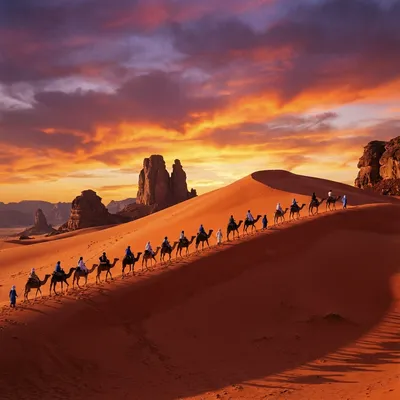
- Optional camel trek: 1-2 days on camelback
Costs: 400-600€ (6d all inclusive)
Circuit 3: Mount Tahat, Tefedest and Climbing — For Mountaineers
Mount Tahat (2,918 m): Algeria’s highest peak
- Base camp: In Ezzane (1,800 m)
- Ascent route: 2 days with porters/mules
- Elevation gain: ~1,100 m (moderate but altitude)
- Costs: 300-400€ (4d)
Circuit 4: Aquatic Canyoning (7-10 days)
For those integrating water into adventure
- Immidir: Deep gorges, successive gueltas
- Tesnou: Basaltic canyons, rare waterfalls
- Technique: Rappelling, icy water swimming, wet climbing
- Costs: 600-1000€
Circuit 5: Astrotourism and Night Observation
Exceptional conditions: magnitude 8.5+ (comparable to La Palma observatory)
- Sirius Astronomy Association: Telescope circuits (30-50€ per night session)
- Observable phenomena: Milky Way, Gegenschein, reflected austral auroras
Charles de Foucauld: Hermit, Linguist, Martyr Canonized 2022 {#dimensions}
Father Charles de Foucauld (1858-1916) transcends simple tourist narrative. Rare intersection: spirituality + linguistic science + colonial geopolitics.
Biographical Journey
- Military career: Non-commissioned officer Algeria 1880-1886
- Spiritual conversion: Meeting Marie de Magdala (mystic), 1889
- Saharan eremitism: Tamanrasset 1905, Assekrem hermitage 1911
- Assassination: December 1916 (political misunderstanding with local WWI tribes)
- Posthumous legitimation: Beatification 2005, Canonization 2022
Linguistic Heritage: Touareg-French Dictionary
Foucauld compiled the “Touareg-French Dictionary” (~1200 manuscript pages), absolute reference. Still used 2025 by linguists and anthropologists.
Tourist Memorials
- Assekrem Hermitage: Oratory, relics, weekly mass (Sunday 9am)
- Foucauld House (Tamanrasset): “La Frégate”, assassination site, managed by Little Brothers of Jesus
- Pilgrimages: 100-200 Catholics/year (French, Swiss, Italians)
Conservation: Existential Urgency
Current Threats
Climate Change: IPCC AR6 predicts Sahara drying 30-50% by 2070.
Tourist Pressure: 8,000-20,000 visitors/month peak season (growing).
Aquifer Overexploitation: SASS system 40 billion m³ total. Current withdrawals 1-2 billion m³/year. Depletion estimated 20-25 years at current rate.
Conservation Strategies
1. Scientific Research: Isotopic hydrology, gene banks, annual population monitoring.
2. Community Engagement: Local guide training, Kel Ahaggar tourism revenue sharing.
3. UNESCO Reinforcement: Imzad protection programs since 2013.
Conclusion: Millennial Rendezvous
Tamanrasset and Hoggar are not just adventure tourism destinations. They are living planetary archives:
Geologically: 250 km³ of magmatic violence spanning 23 million years.
Culturally: Beating heart of Kel Ahaggar civilization, matriarchy preserving itself.
Spiritually: Charles de Foucauld’s legacy, now a canonized saint.
Ecologically: Last refuge of the Saharan cheetah, Laperrine’s olive, Neolithic relics.
Go to Tamanrasset. Respect this millennial rendezvous. Return transformed.
Article written by a certified local expert. Information verified and updated December 2025.