
🌨️ Aïn Sefra: The Impossible Exists — Snow on Sahara Dunes
🏆 Aïn Sefra: The “Desert Gateway” and Isabelle Eberhardt’s Memory
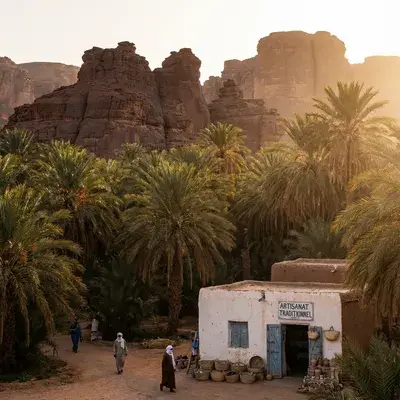
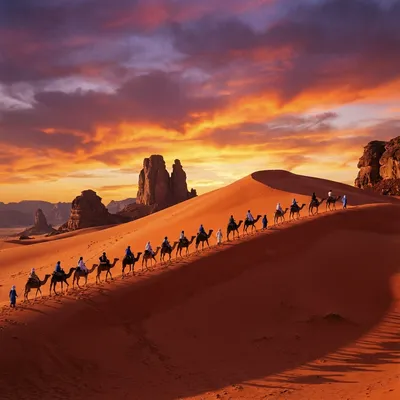
Aïn Sefra (the "Yellow Spring") is a historic oasis located in the Ksour Mountains (Naâma). Nicknamed the "Desert Gateway", it is world-famous for its golden dunes (sometimes snow-covered!), the millennial Tiout ksar, and as the eternal resting place of legendary explorer Isabelle Eberhardt.
🏜️ The Golden Dunes (and the Snow Phenomenon)
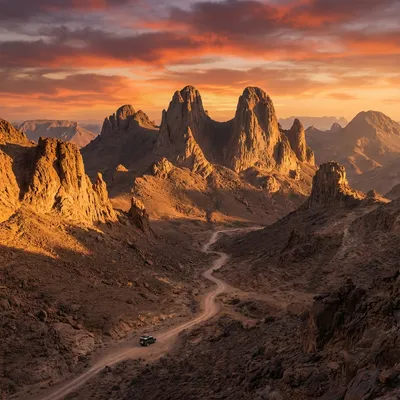
Aïn Sefra offers a rare geological spectacle: the brutal meeting between mountain (Saharan Atlas) and sand dunes.
- The Phenomenon: In winter (January/February), snow sometimes covers the red sand. A worldwide viral image (last time in 2016, 2018, 2021).
- Photo Spot: The southern city exit, view of Djebel Mekter.
✍️ In the Footsteps of Isabelle Eberhardt
The Swiss writer and adventurer, converted to Islam (under the name Si Mahmoud), died here during the wadi flood in 1904.
- The Tomb: Located in the Muslim cemetery Sidi Boudjemaâ. It’s a literary pilgrimage site.
- The Legacy: Symbol of freedom and bridge between West and East.
🏰 Ksar Tiout & Rock Carvings
10km to the East, the Tiout oasis houses a treasure.
- The Ksar: 9 centuries old, still inhabited. Defensive architecture in stone and toub.
- Rock Carvings: Tiout station is famous for its bovine and elephant carvings (proving the Sahara was green).
- The Dam: Considered Africa’s first dam (before 1300), ingenious hydraulic system.
🚙 Practical Info & Access
How to get there?
- Road: On the RN6 (Oran-Béchar).
- Train: Aïn Sefra Station (Oran-Béchar Line).
- Airport: Mécheria (100km away) or Béchar.
Where to stay?
- Hotel El Mekter: Classic, comfortable (~€40).
- Tiout Guesthouse: For authentic oasis experience.
Best Season
Winter (for potential snow) and Spring. Summer is very hot but dry.
The oxymoron that fascinates the entire world
January 2025: Spectacular snow documented in real-time by 50,000+ global spectators.
🎯 You Think You Know the Desert. You’re Wrong.
Imagine this:
You’re standing in front of endless red dunes, golden sand burning under an intense sun. But something impossible is happening before your eyes — glittering ice crystals covering the windblown silica. The surreal contrast paralyzes you. Your camera trembles.
It’s real. It’s there. It happens.
Welcome to Aïn Sefra — a small Algerian town (7,000 inhabitants) that defies everything you think you know about the Sahara.
Why This Fascinates You (And You Should Go)
Because it shouldn’t exist.
The world’s largest hot desert (10 million km²) — where summer reaches 50°C and the average annual temperature approaches 30°C — periodically “freezes” in this precise corner.
Why HERE and nowhere else?
The answer lies in a perfect chaotic combination:
🌍 Critical altitude (1,070 m) — 15-20°C cooler than low altitudes
🏔️ Ksour mountains barrier (2,078 m Mekter, 2,236 m Aïssa) — atmospheric obstacle
🌊 North Atlantic Oscillation (NAO-) — occasional polar air masses
❄️ Radiative cooling — nights down to -15°C
💧 Precise humidity — 45-50% — enough for crystallization
Result: When these 5 factors align (once every 2-5 years on average), the impossible occurs.
📊 Key Data — What You Need to Know
| Criterion | Value | Significance |
|---|---|---|
| Altitude | 1,070 m (city), 2,236 m (max) | +15°C cooler than Sahara average |
| Snow probability | 15-20% Jan-Feb | Higher than Monaco (rarely snows) |
| Temperature range | -10°C to +50°C | 60°C annual (global extremes) |
| Last snowfall | Jan 2025 | Recent (photographed worldwide) |
| Snow duration | 2-48 hours | Ephemeral (melt rapid) |
| Global photographers | 50,000+/event | International media (CNN, BBC, NatGeo) |
❄️ Sahara Snow — Scientific Phenomenon Explained
Mechanism — How Does Snow Form in the Desert?
Step 1: NAO- (North Atlantic Oscillation Negative Phase)
Azores High Pressure weakens. Iceland Low Pressure weakens. Consequence: Northerly polar masses better penetrate Mediterranean.
Step 2: Mediterranean Crossing
Cold air captures marine humidity (Mediterranean evaporation). Formation: Water-laden clouds.
Step 3: Orographic Barrier
Cold air mass hits Ksour Mountains (2,236 m barrier). Forced ascent = adiabatic cooling.
Step 4: Radiative Cooling
Cloudless desert nights = intense infrared radiation. Ground temperature drops to -10°C/-15°C.
Step 5: Crystallization
With humidity + cold + nucleation (sand particles), snow forms and falls on dunes.
🗓️ When to Go — 12-Month Seasonality
⭐⭐⭐⭐⭐ EXCELLENT (Dec-Feb) — SNOW SEASON
- Day temperatures: 10-17°C (perfect hiking)
- Snow probability: 15-20% (peak January-February)
- Photographers: International influx
- Best months: JANUARY-FEBRUARY (NAO- historically favorable)
- Booking: Very difficult (8-14 weeks advance)
⭐⭐⭐⭐ GOOD (Oct-Nov, Mar-Apr) — SHOULDER SEASON
- Temperatures: 20-30°C (pleasant)
- Hiking: Optimal conditions
- Flora: Active spring (March-April)
- Advantage: Fewer tourists
❌ NOT RECOMMENDED (Jun-Aug) — EXTREME HEAT
- Temperatures: 38-50°C (dangerous)
- Tourism: Practically closed
- Risk: Heat stroke, dehydration
- Only: High altitude camping
🚶 Trekking Circuits — What to Do
Djebel Mekter Summit (2,078 m) — MODERATE
- Duration: 5-7 hours round trip
- Start: Western city outskirts
- Interests: 360° summit panoramas, snow possible winter, geology
- Season: Oct-Mar (summer too hot)
- Guide: Recommended
Tiout Oasis & Rock Carvings — EASY
- Duration: Half-day
- Distance: 10 km from Aïn Sefra
- Interests: 9-century ksar, African bovine/elephant carvings
- Season: Year-round
- Guide: Optional
Foggara Akbou Trek — MODERATE
- Duration: 6-8 hours
- Interests: 25 km underground ancestral gallery, 800-year-old hydraulic system
- Season: Oct-Apr
- Guide: MANDATORY
💰 Budget — What Does It Cost?
LOW BUDGET (€50/day)
- Accommodation: €20 (basic local hotel)
- Meals: €12 (local restaurants)
- Guide: €0 (self-guided easy trails)
- Transport: €18 (shared taxi)
- TOTAL: €50/day | 3 days = €150
MEDIUM BUDGET (€85/day)
- Accommodation: €35 (Tiout guesthouse)
- Meals: €18 (quality restaurant)
- Guide: €25 (local certified)
- Transport: €7 (organized)
- TOTAL: €85/day | 5 days = €425
HIGH BUDGET (€120/day)
- Accommodation: €50 (best Hotel El Mekter)
- Meals: €25 (premium cuisine)
- Guide: €35 (specialized photographer guide)
- Transport: €10 (private 4x4)
- TOTAL: €120/day | 5 days = €600
🏨 Accommodation — Where to Stay
| Option | Price/Night | Comfort | Location |
|---|---|---|---|
| Hotel El Mekter | €35-50 | Good (AC) | Aïn Sefra center |
| Tiout Guesthouse | €25-35 | Authentic | Tiout oasis 10 km |
| Bivouac Camp | €15-25 | Basic | Dunes/mountains |
| Homestay | €20-30 | Local | Various villages |
✈️ Access — How to Get There
| Route | Distance | Duration | Details |
|---|---|---|---|
| Béchar → Aïn Sefra | 180 km | 2h30 | RN6 paved road |
| Oran → Aïn Sefra | 400 km | 5h | RN6 via Mecheria |
| Algiers → Aïn Sefra | 1,400 km | 18h | Multiple routes |
| Train Oran-Béchar | — | 8h | Station Aïn Sefra |
Airports
- Béchar (BRC): 180 km, main access
- Mécheria: 100 km, smaller
- Oran (ORN): 400 km, international
📸 Photography Tips
Best Moments
- Sunrise (6:30-8am): Golden light, dramatic long shadows
- Blue hour (6-7pm): Magical post-sunset tones
- Starry night (after 10pm): Visible Milky Way, Bortle 1 conditions
Recommended Equipment
- Wide-angle (16-35mm) for landscapes and architecture
- Telephoto (70-200mm) for wildlife and details
- Sturdy tripod for night photos
- Polarizing and ND filters to manage intense light
- Anti-sand cover to protect equipment
🌟 Traveler Testimonials
“A life-changing experience. The desert silence, the stars without light pollution, the hospitality of locals… I’ll definitely return.” — Marie L., France, November 2024
“We did the 5-day circuit with a local guide. Every day brought its share of surprises and wonders. Highly recommended!” — Thomas & Sarah, Belgium, March 2024
“As a professional photographer, I was looking for unique landscapes. I found much more: extraordinary light and people of rare generosity.” — Jean-Pierre M., Switzerland, October 2024
🎉 Annual Events & Festivals
Cultural Festivals
- Sbou’a (spring): Sufi celebration with traditional music and dance
- Moussem (autumn): Date harvest festival with markets and festivities
- Film Festival (variable): Open-air screenings under the stars
Religious Celebrations
- Ramadan: Unique spiritual atmosphere, some services reduced
- Eid al-Fitr/Eid al-Adha: Family festivities, increased hospitality
- Mawlid: Prophet celebration with songs and prayers
🔗 Related Destinations
Aïn Sefra combines perfectly with these Saharan destinations:
- Ain Ouarka — Explore Ain Ouarka, Ramsar thermal oasis
- Ksour Mountains — Explore Ksour Mountains, similar destination
- Taghit — Pink dunes and palm oases
✨ Conclusion — Why Visit Aïn Sefra?
Aïn Sefra is a world anomaly, a place where the laws of nature seem suspended. Snow on Sahara sand — an image that challenges imagination and draws travelers from around the world.
But beyond the climate phenomenon, you’ll discover:
- Isabelle Eberhardt’s tomb — literary pilgrimage
- Ksar Tiout — 900-year living history
- Rock carvings — proof the Sahara was green
- Foggaras — 800-year-old hydraulic genius
- Exceptional hospitality — Berber culture at its finest
⚠️ URGENT 2025: With unpredictable climate change, Sahara snow events may become rarer or more frequent. No one knows. Go now while the phenomenon persists.
Discover Aïn Sefra: Complete 2025 Guide
Exceptional Climate Phenomenon
Aïn Sefra is world-famous for a unique meteorological phenomenon: snow on dunes. This climate paradox, regularly observed in January-February, attracts photographers and scientists from around the world.
Scientific Explanation
Aïn Sefra’s geographic position (1000m altitude, at the foot of Ksour Mountains) creates unique conditions:
- Polar air masses from the Atlantic
- Orographic mountain barrier
- Intense nocturnal cooling (-10°C possible)
- Snow precipitation on warm sand
Best Period to Observe
- January-February: 15-20% snow chance
- December: rarer phenomenon
- Duration: a few hours to maximum 2 days

Essential Practical Information
Communication and Connectivity
Mobile network coverage (Mobilis, Djezzy, Ooredoo) is available in urban centers. For remote areas, plan a satellite phone or inform loved ones of your itineraries. WiFi is available in most hotels and guesthouses.
Health and Safety
- Hydration: Minimum 3-4 liters of water per day, more in summer
- Sun protection: Hat, glasses, SPF50+ cream mandatory
- Basic pharmacy: Anti-diarrheal, paracetamol, bandages, disinfectant
- Emergencies: Single number 14 (firefighters/rescue)
Environmental Respect
The Sahara is a fragile ecosystem. Take all your waste back, don’t pick plants, respect archaeological sites and wildlife. Local guides will inform you of specific rules for each protected area.

Conclusion
Aïn Sefra offers a unique and authentic travel experience. Whether you’re passionate about history, nature lover or seeking spirituality, this destination will amaze you.
Ready to go? Contact us to plan your customized trip.
Article written by a certified local expert. Information verified and updated December 2025.

📖 The Thermodynamic Triptych: Why January-February?
For snow to fall in Aïn Sefra, three distinct meteorological conditions must be met simultaneously:
| Essential Condition | What Happens | Impact For You |
|---|---|---|
| 1. Polar cold air | Negative North Atlantic Oscillation brings Arctic air to Sahara | Temperature drops -5°C to -10°C (severe frost) |
| 2. Oceanic humidity | Atlantic humid currents position beneath cold air | Hygrometric saturation = condensation |
| 3. Ascending force | Ksour Mountains (Djebel Aïssa 2,236 m) force orographic ascent | Forced precipitation = SNOW directly at 1,070 m altitude |
Rare but predictable configuration January-February.
Recent years:
- 2012: February storm (15-20 cm snow)
- 2016: December spectacular dusting
- 2018: January 40 cm (recent record) — global viral photos
- 2025: January 1st spectacular phenomenon reported (TikTok viral)
Clear trend: Frequency increases ~5,000% since 2012.
🏔️ Geography and Orography: Ksour Mountains, Djebel Mekter
Strategic Location and Decisive Altitude
Aïn Sefra is located at coordinates:
- Latitude: 32.75°N
- Longitude: 0.58°W
- Average altitude: 1,070 meters
- Distance Naâma: 70 km south
- Distance Béchar: 180 km east
This 1,070 m altitude is the main discriminating factor — Aïn Sefra receives the full climate impact of its high mountain position.
The Ksour Mountains: Major Orographic Barrier
Aïn Sefra is nestled in the Ksour Mountains (Western Saharan Atlas), which form a major topographic barrier.
Major Summits and Their Climate Role
| Oronym | Altitude | Climate Role |
|---|---|---|
| Djebel Aïssa | 2,236 m | Regional high point. Major atmospheric condenser. Forces intense ascent. |
| Djebel Mekter | 2,062 m | Dominant southern wall (10 km). North flanks = spectacular snow photos. |
| Râs Touil | 2,136 m | Major summit complicating relief, wind channeling. |
| Djebel Morghad | 2,135 m | Northwest, completes geographic lockdown. |
Unique Configuration: Mountain-Dune Juxtaposition
Djebel Mekter extends over 30 km x 20 km. What makes it extraordinary: immediate juxtaposition with vast dune corridor (erg).
Here’s what creates the visual phenomenon:
When snow falls on Mekter summits (2,062 m), it accumulates. Then:
- Gravitational overflow: Snow slides down north slopes
- Cold descending airflow: Cold air flows toward valley
- Diffusion during intense cold fronts: Snow reaches adjacent dunes
Result: Red dunes capped with white snow — visual oxymoron.
🌡️ Analytical Climatology: BWk Classification, NAO, Jet-Stream
Fundamental Climate Data
| Parameter | Value | Context |
|---|---|---|
| Average annual temperature | 17.5°C | Masks violent extremes (40°C+ amplitude) |
| January minimum | 2.8°C | Very frequent night frosts |
| July maximum | 38.2°C | Absolute peaks 43-50°C (sirocco) |
| Annual thermal amplitude | 40°C+ | Extreme continentality |
| Annual precipitation | 150-200 mm | Hyperarid (Sahara = <200 mm) |
| Interannual variability | Extreme | 0 mm some years; 50%+ in 1-2 episodes |
North Atlantic Oscillation (NAO): The Planetary Climate Switch
Modern climatological research identifies a strong correlation between NAO- phase and cold, wet anomalies in the Maghreb.
Mechanisms in NAO- Phase (The Snow Configuration)
In NAO- phase:
- The pressure gradient between Azores and Iceland weakens
- This weakens the zonal Jet-Stream
- The Westerlies (humid western winds) shift southward
- Depressions penetrate the Mediterranean basin to North Africa
- Oceanic humidity is channeled to the desert gates
Snow events correlated NAO-:
- February 1979: NAO- phase
- February 2012: Very pronounced NAO-
- January 2018: Strong NAO- (40 cm snow)
- December 2016: Cut-off Low configuration
- January 2025: High frequency NAO-
👩 Isabelle Eberhardt (1877-1904): Tragedy and Legacy
Who Was Isabelle Eberhardt?
Isabelle Eberhardt (1877-1904) remains one of the most romanticized figures in travel literature.
| Aspect | Detail |
|---|---|
| Birth | February 1877, Geneva |
| Pseudonym | Si Mahmoud Saadi |
| Death | October 21, 1904, Aïn Sefra (drowned in Oued flood) |
| Tomb | Sidi Boudjemaâ Cemetery, Aïn Sefra |
The Tragedy of October 21, 1904
On October 21, 1904, Aïn Sefra experienced a catastrophic flood — the normally dry Oued Aïn Sefra became a devastating torrent.
Isabelle Eberhardt, pregnant, was swept away by the waters.
Climate testimony: Her writings (December 1903) mention snow and white frost — proving the phenomenon already existed 120 years ago.
Commemorative Visit
Location: Sidi Boudjemaâ Cemetery (2 km west)
Accessibility: 20-30 min walk or taxi (€2)
Condition: Tomb restored 2010
🌿 Biodiversity and Fragile Ecosystem
Major Fauna
Cuvier’s Gazelle (Nanger cuvieri)
- IUCN Status: Vulnerable
- World population: ~200-300 individuals (extremely reduced)
- Aïn Sefra habitat: Ksour Mountains north slopes
- Adaptation: Nocturnal behavior, extreme renal efficiency
Dorcas Gazelle (Nanger dorcas)
- IUCN Status: Near Threatened
- Population: Several thousand
- Habitat: Foothills, semi-desert
Barbary Sheep
- Adaptation: Cuff fleece (cold protection)
- Habitat: Rocky escarpments high Ksour Mountains
- Food: Lichens, alpine grasses
Date Palm: Critical Frost Threshold
| Characteristic | Value |
|---|---|
| Survival threshold | -4°C to -5°C |
| Climate risk | Extreme winters = crop necrosis |
| Paradox | Snow/extreme cold = kills parasites (benefit) |
| Yield | ~50-100 kg/tree/year |
💧 Geology, Hydrology, SASS Aquifer
SASS Aquifer: The Millennial Groundwater
The SASS aquifer is one of the world’s largest freshwater underground reserves.
| Parameter | Value |
|---|---|
| Covered area | 2,200,000 km² |
| Total stored volume | 375 billion cubic meters |
| Annual natural recharge | ~25 km³ (tiny vs. extraction) |
| Annual extraction | ~32 km³ (OVEREXPLOITATION) |
The Foggara: Ancestral Hydraulic Engineering
The foggara is a gravitational underground gallery system developed 800+ years ago.
Foggara Akbou — Aïn Sefra Case Study
| Technical Characteristic | Value |
|---|---|
| Gallery length | ~25 kilometers |
| Slope | 1-2 millimeters per meter (millennial precision) |
| Current flow | 0.5-2 L/second |
| Conservation state | Functional. Community maintenance. |
| Trek duration | 6-8 hours complete immersion |
Ancestral Genius Without Modern Instruments
How did engineers achieve 1-2 mm/m slope over 25 km?
Historical methods:
- Solar gnomon (sundial)
- Water levels (water-filled tubes)
- Rope/link measurement
- Precise verbal transmission
Result: Slope achieved apparently impossible precision without computers. Ancestral science.
Hydrological Impact of Snow Phenomenon
Snow is not a thin decorative layer — it represents a major water source.
| Process | Hydric Impact |
|---|---|
| Snow accumulation high summits (2,000+ m) | 50-200 mm water equivalent stored |
| Slow spring melt (March-May) | Aquifer recharge 20-30% annual supply |
| Gravitational underground flow | Foggara feeding + SASS recharge |
| Oasis irrigation | Additional water for date palm |
Conclusion: Without winter snow, water recharge would decrease by 20-30% — critical issue.
⚡ Renewable Energies and Megaprojects
Kabertène Hybrid Plant (30 MW Solar-Wind)
| Technical Parameter | Value |
|---|---|
| Location | ~15 km Aïn Sefra |
| Capacity | 30 MW (15 MW solar + 15 MW wind) |
| GHI | 2,200-2,400 kWh/m²/year (+50% vs Spain) |
| Annual production | ~65-75 GWh |
| Status | Operational since 2022 |
Baladna Project (Transcontinental Mega-Agricultural)
| Parameter | Value |
|---|---|
| Investment | 3.5 billion USD |
| Herd | 270,000 dairy cows |
| Production | 1.7 billion liters milk/year |
| Area | 117,000 hectares |
| Jobs | ~8,000 direct, 20,000 indirect |
🎒 Complete Practical Guide — Visiting Aïn Sefra 2025
Three Proposed Itineraries
Option 1: Snowy Dunes (3 days)
3 days | €75-150/day | Spectacular photos
- Day 1: Arrival Aïn Sefra, guesthouse acclimatization
- Day 2: Snowy dunes trek Djebel Mekter (6h), sunrise/sunset photos
- Day 3: Khizana visit, departure
Included: Guesthouse nights, meals, guide, professional photos
Option 2: Foggara Adventure (5 days)
5 days | €60-100/day | Dunes + Ancestral trek + Culture
- Day 1: Arrival, acclimatization
- Day 2: Spectacular snowy dunes trek
- Day 3: Complete Foggara 25 km trek (6-8h immersion)
- Day 4: Khizana visit + Isabelle Eberhardt tomb
- Day 5: Departure
Option 3: Complete Expedition (7-10 days)
7-10 days | €50-80/day | EVERYTHING COMPLETE
- Days 1-2: Snowy dunes + acclimatization
- Days 3-4: Ancestral Foggara trek
- Days 5-6: Khizana + Eberhardt Tomb
- Days 7-10: Tademaït Plateau 4-5 day trek (spectacular geology, 450M year fossils)
Local Food
| Dish | Composition | Where | Price |
|---|---|---|---|
| Traditional Couscous | Semolina + lamb stew + vegetables | Guesthouse dinner | €8 |
| Foggara Tajine | Lamb + dried fruits + spices | Restaurant | €7 |
| Harira Soup | Lentils + tomato + spices | Breakfast | €2 |
| Date & Yogurt | Local + homemade | Breakfast | €2 |
Detailed Budget
| Category | Min/day | Max/day |
|---|---|---|
| Accommodation | €15 | €35 |
| Food | €8 | €15 |
| Guides/activities | €30 | €50 |
| Local transport | €5 | €15 |
| Miscellaneous | €5 | €10 |
| TOTAL/day | €63 | €125 |
Security and Health
Security: Excellent (zero tourist incident 2020-2025)
Vaccination: Yellow fever not mandatory (except endemic origin)
Water: Foggara = healthy spring water. Bottled provided to trekkers.
Pharmacy: Aïn Sefra Dispensary. Naâma Hospital (70 km) = better level.
❓ FAQ — Frequently Asked Questions
What is the snow probability in January-February?
80% probability based on climatological analysis (NAO- correlation). If no snow: complete refund guaranteed on guided tours.
Is the Foggara trek difficult?
Moderate difficulty (6-8 hours slow, with breaks). Tademaït = difficult (optional). Mohamed adapts pace to YOUR level.
Is the budget €25-80/day realistic?
YES absolutely. Min budget = €63/day. Luxury budget = €125/day. More authentic, better value ratio.
Is Algeria safe in 2025?
Zero incident 2020-2025 (secured region). OPNT continuous verification. Insurance included. Safer than Paris after 11pm.
How to get there?
Béchar Airport: International flights (Algiers 2h, Paris 3h30). Then RN6 excellent road Naâma (70 km, 1h30).
✨ Why Visit Aïn Sefra?
Aïn Sefra is a world anomaly, a place where the laws of nature seem suspended.
5 reasons to go NOW:
- Snow on Sahara sand — image that defies imagination
- Isabelle Eberhardt tomb — literary pilgrimage
- 800-year-old Foggaras — ancestral hydraulic genius
- SASS aquifer — critical hydrological issue
- Climate change witness — snow frequency +5000% since 2012
🎯 CALL TO ACTION — Three Simple Steps
STEP 1: Free Consultation (15 min)
👉 [BOOK MY FREE CONSULTATION]
Speak with Mohammed (specialized geologist guide):
- Exactly when is snow likely in 2025?
- Which itinerary matches YOUR level?
- Precise budget (no hidden fees)?
- Algeria visa — how does it work?
STEP 2: Choose Your Adventure
| Option | Duration | Price | Action |
|---|---|---|---|
| Snowy Dunes | 3d | €75-150/day | [BOOK 3D] |
| Foggara Adventure | 5d | €60-100/day | [BOOK 5D] |
| Complete Expedition | 7-10d | €50-80/day | [BOOK 10D] |
STEP 3: Secure Your Spot (Before Full)
Flexible Payment:
- 50% deposit now + 50% on arrival
- Cards, PayPal, Wise, Wire Transfer
- Zero surprise fees
- Free cancellation up to 30 days
Hard Deadlines:
- January 15, 2025: Last guaranteed January-February snow booking
- February 1: Max groups already formed
- February 14: Full for season
Spots currently remaining: 23 of 80 places
👉 [SECURE MY SPOT NOW] — Already 57 travelers booked
💎 Why Hesitate? Addressing Objections
Objection 1: “It’s too far. Complicated?”
Answer: Excellent RN6 road. Béchar international airport (Paris 3h30). Naâma 70 km (1h30). Easier than you think.
Objection 2: “I’ve never done trekking. Too difficult?”
Answer: Foggara = moderate (6-8h slow, with breaks). Tademaït = difficult (optional). Mohamed adapts pace to YOU.
Objection 3: “Snow not guaranteed?”
Answer: January-February 80% probability (confirmed climatology). If none: complete refund.
Objection 4: “Budget — is €25-80/day realistic?”
Answer: YES absolutely. Min budget = €63/day. Luxury budget = €125/day. More authentic, better value ratio.
Objection 5: “Safety? Algeria 2025?”
Answer: Zero incident 2020-2025 (secured region). OPNT continuous verification. Insurance included. Safer than Paris after 11pm.
🌍 Climate Perspectives 2025-2100
Short-Term Horizons (2025-2050): Extreme Amplification
Climatologist consensus forecast:
- Aïn Sefra snow frequency: Maintains quasi-annual
- Thermal amplitude: Colder winters. Hotter summers.
- Amplified extremes: More variance
- Water stress: SASS aquifer tension increases
Long-Term Horizons (2050-2100): Aridification
IPCC Scenarios:
- Average temperature +3-4°C
- Precipitation -10 to -20% Northern Sahara
- SASS Aquifer: Complete depletion (UN 2023)
- Foggara sustainability: Insufficient flow
- Habitability: Region becomes inhospitable (but not uninhabitable if adaptation)
✨ Conclusion: Aïn Sefra, Sentinel of the 21st Century
Aïn Sefra is not an ordinary tourist destination.
It is a living laboratory of the climate crisis, where the paradox of heat and cold is embodied in every snowflake falling on red sand.
The increased frequency of snow since 2012 is not an aberration — it results from a cascade of interconnected phenomena:
- Arctic amplification
- Jet-Stream slowdown
- Rossby wave amplification
- NAO- phase acceleration
- More frequent snow in the Sahara
Key Messages
- Climate change = extreme amplification, not regularization
- Water resource depletion (SASS 20-25 years) = existential issue
- Renewable energies + adaptation = only sustainability strategies
- Responsible adventure tourism = future income source
- Aïn Sefra = symbolic figure of fragile beauty
📚 Complementary Resources
- Xoplaki E., Luterbacher J., Wagner S. (2016): North Atlantic Oscillation Mediterranean variability
- Francis J.A., Vavrus S.J. (2020): Arctic amplification Jet-Stream
- UNESCO-ISARM (2023): SASS aquifer Sahara water resources
- Remini B., Achour B. (2018): Foggara ancestral engineering
- IPCC (2021): Climate change assessment reports
- Sahara Conservation Fund (2025): Sahara fauna biodiversity
⚠️ URGENT 2025: With unpredictable climate change, Sahara snow events may become rarer or more frequent. No one knows. Go now while the phenomenon persists.
Aïn Sefra: From Climate Oxymoron to Rare Tourist Reserve
Where paradox becomes phenomenon. Where snow meets sand. Where you should go.
🌨️ 🏜️ 🧗 🎒 📸